The Future of Industrial SaaS: Grayson ai's Strategic Thesis
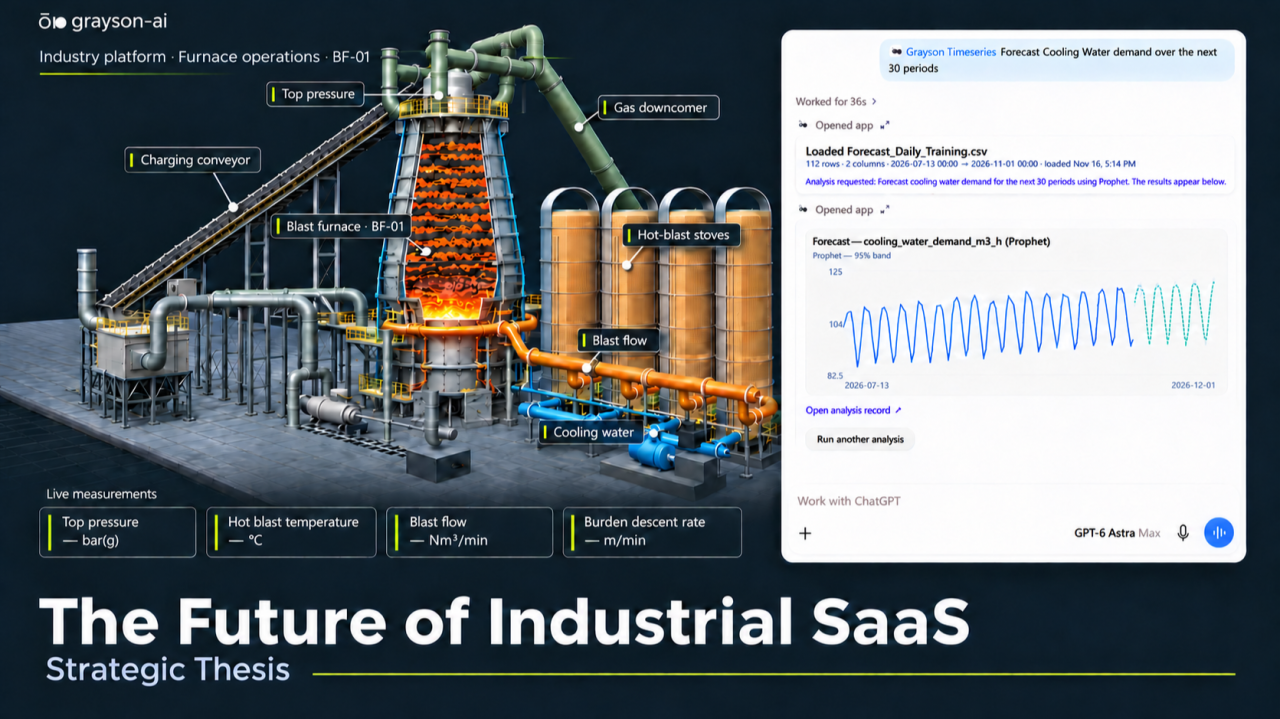
At Grayson AI, we are focused on supporting industrial clients to have fewer shutdowns and incidents, by giving them tools that support predictive maintenance and that can lead to lower-effort, highly accurate root cause analysis. We believe enterprise AI is entering a period of significant change. We have built a deterministic layer for process data that now works inside the AI tools engineers already use, including ChatGPT and Microsoft Teams. Three ideas are shaping our strategy, and how we see the future of enterprise AI unfolding.
Key takeaways
- Enterprise AI is entering an App Store moment. Engineers want AI in the tools they already use, and companies will trust agents a marketplace has reviewed.
- Industrial SaaS reaches those tools through an MCP server, including Microsoft Teams and ChatGPT, rather than through another standalone interface.
- Process data still needs a deterministic layer. Established algorithms do the calculation. The language model helps ask the question and explain a result that can be rerun and audited.
In this article
An App Store moment for the enterprise
We believe we are entering an App Store moment for the enterprise. People want to use AI for their work, and companies want the corresponding advantages, but both need to be able to trust the agents they use. Approved agents, distributed through marketplaces, are how that trust gets established.
Industrial users do not want another platform. They want the tools they already use every day, such as ChatGPT and Microsoft Teams. The consumer parallel is the iPhone in 2008. People loved the phone, Apple wanted to protect its reputation, and the App Store became the place where Apple reviewed and approved apps. That review is what let app use take off, while the competing idea of browser-based mobile applications lost ground. Our view is that the Microsoft Marketplace, and others such as the ChatGPT marketplace, will provide that same confidence for enterprise AI users in 2027.
We have been early in that shift. In July 2026 we deployed the first standalone time-series agents on the Microsoft Teams Marketplace. In November 2026 we deployed the first time-series agents on ChatGPT's marketplace. The rigor both companies applied before approving the applications is a sign they want agents on those marketplaces to be safe and valuable. We intend to accelerate these deployments.
The future of SaaS is via an MCP server
That distribution works because we believe users will increasingly reach SaaS through MCP-connected AI tools, rather than through a separate software interface. We are not building our own chat product. We connect our agents to the tools engineers already use. People work in Copilot in Microsoft Teams, ChatGPT, Gemini, Grok, and Claude, and they already like that experience. There is no reason to make them learn a new one when the connection can be direct.
We deploy the agents through our MCP server. Microsoft Teams and ChatGPT keep their marketplace listings. Claude, Gemini, and Grok use that MCP server as a custom connector. Marketplace approval and an MCP connection, together, are how we expect the barrier to enterprise adoption to come down.
A deterministic layer for process data
The third tenet is that process engineers need to trust the numbers they see. They may use Copilot and ChatGPT to draft email, organize files, and do research. Until recently they could not use those same tools to analyze sensor data with confidence, because LLMs are not deterministic.
When a general-purpose AI tool does math or a more complex analysis, it generally writes new code for that request. The code decides which data to use and which calculations to run, and then it follows those instructions exactly, even when the model has misread the question. Hallucinations can enter at more than one step. Ask for the same analysis twice and the answer can change. That is the risk.
We take a different approach. Established, repeatable algorithms and machine-learning models perform the analysis. The AI helps you ask the question and understand the result. The numbers come from the deterministic layer, so the same analysis can be rerun and audited.
Where this leads
We believe this is an early version of something that will help engineers get answers in minutes, and that supports our longer view of plants that keep improving. The marketplace listings put the agents where engineers already work. The MCP server is how those tools reach the analysis. The deterministic layer is why the numbers can be checked.
If this resonates, reach out. I would like to discuss it.
Chad Ford
President, Grayson ai
This thesis was first published on LinkedIn on November 17, 2026.
Next step
Try Grayson free, or keep reading
Ask your process data a question today.
Free. No credit card. Set up in under two minutes.
Use Grayson Free