1
Open Grayson
Connect Grayson Timeseries to ChatGPT and select it in your conversation.
 ChatGPT
Ad hoc anomaly detection, forecasting, correlation, and data-quality checks for operations, maintenance, and reliability teams. No code required.
Free to add in ChatGPT. No credit card to start.
Using Grayson
Connect Grayson Timeseries to ChatGPT and select it in your conversation.
Upload a CSV with timestamps and the sensor tags you want to investigate.
CSVbearing_vibration.csv
Ask which readings stood out. Review the flagged points, chart, and recorded settings.
IQRVibration anomaly detection
Illustrated workflow with an example CSV.
Try this promptUse Grayson to run IQR anomaly detection on the bearing vibration column. Show me which readings were flagged, their timestamps, and the settings you used.
Example questions and charts already published for Grayson Timeseries.
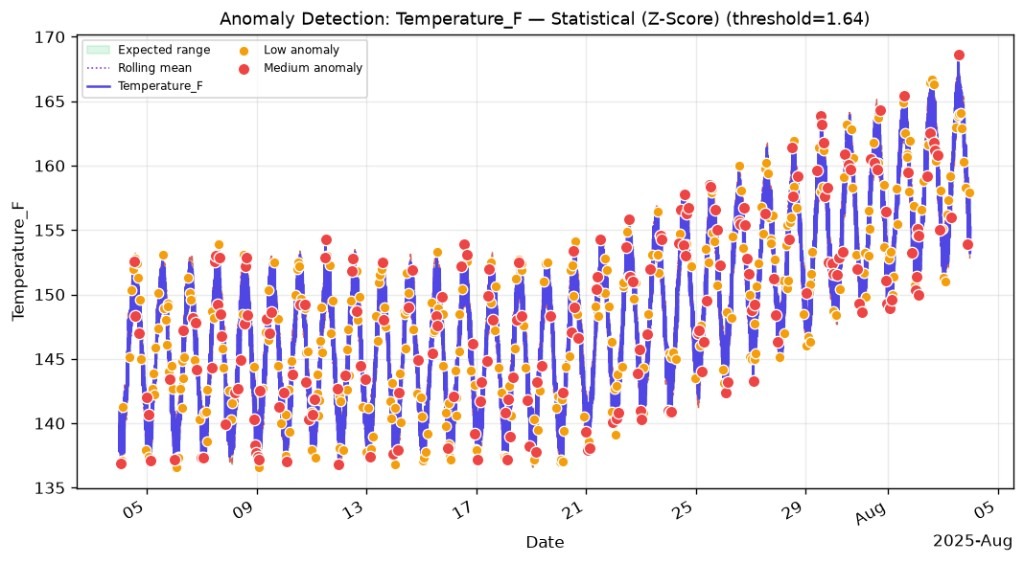
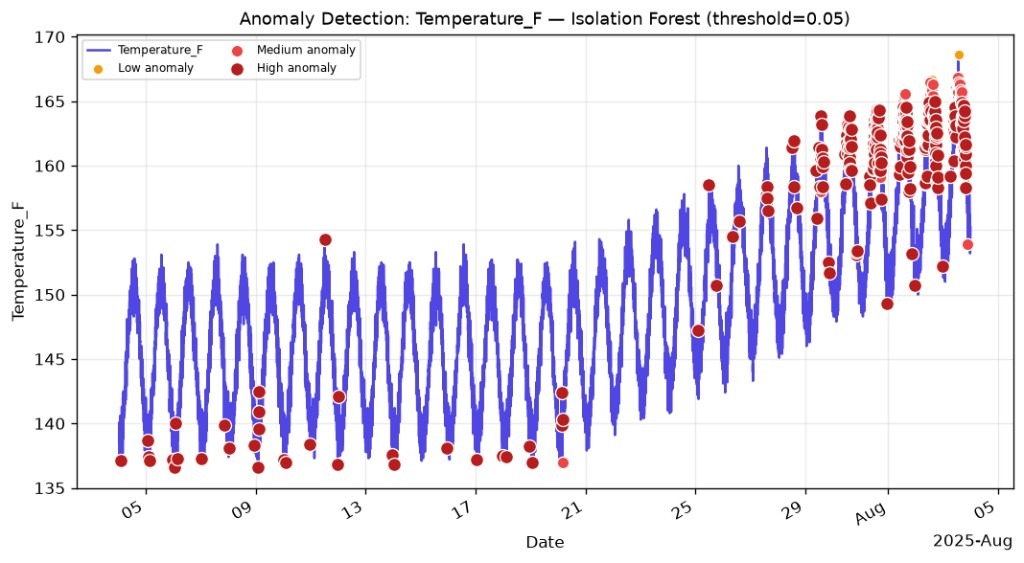
Anomaly detection
Find spikes and shifts with Isolation Forest, Z-score, or interquartile range.
“Detect anomalies in temperature.”
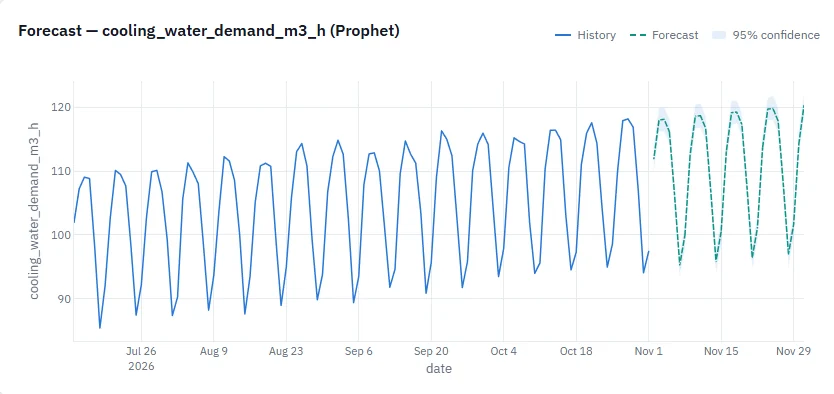
Forecasting
Compare Prophet with a simple moving average and a linear trend.
“When will cooling-water demand peak?”
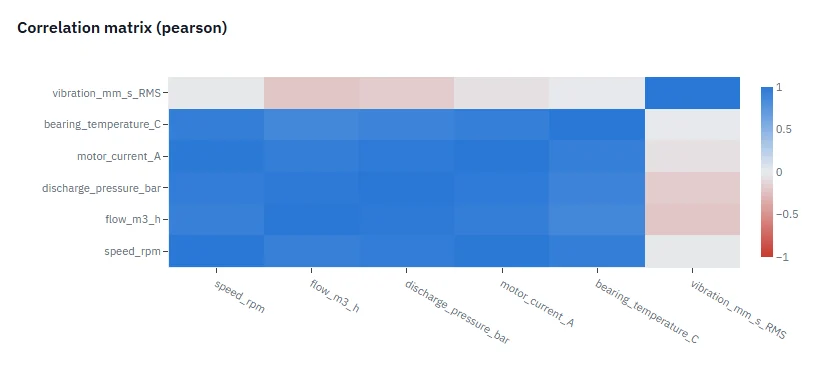
Correlation
Line a tag up with the signals around it using Pearson, Spearman, or rolling correlation.
“What moves with motor current?”
Why deterministic matters
When an AI tool like ChatGPT or Microsoft Copilot does math or complex data analysis, it writes its own computer code to perform the calculations to decide what data to use, which calculations to perform, and how to write the instructions. It then has a separate computer execute this code.
The problem? The computer follows the instructions exactly, even if the AI has chosen the wrong data, formula, or method. In addition, hallucinations can occur at two points: when the AI writes the code and when it explains the results. This means each time you ask for analysis you can get different answers — hence the risk.
Grayson takes a different approach by using established, repeatable algorithms and machine-learning models to perform the analysis, while AI helps you ask questions and understand the results.
| Benefit | General-purpose LLM | Grayson |
|---|---|---|
| Numbers you can trust | May generate analytical code or methods differently across runs. | Deterministic models perform the calculation; results can be rerun and audited. |
| Structured user interface | Often begins from a blank prompt — useful only if the user knows what to ask. | Guided analysis controls structure the workflow without removing conversation. |
| Minimized token usage | May spend tokens regenerating analytical code and reasoning through implementation. | Calls reusable analytical tools instead of recreating them each time — especially important with large data sets. |
| Multi-platform Advantage | The analysis stays in the chat of the specific tool where it was asked. | The same analysis can be opened from the tools you already use, in the office or in the field, connected by the deterministic layer. |
| Speed | Getting a number means waiting while the model works out a method. | Ideal for fast, trusted, back of the napkin calculations. |
Use the LLM for interaction and context. Use deterministic tools for the calculation.
This page starts in ChatGPT. Microsoft Teams is the organization-managed route. Timeseries Premium adds a workspace for deeper review, and Grayson Industry is the shared deployment.
